Dentists, vaccinations and pregnancy on the NHS: how it works in England
How to find an NHS dentist and what you will pay, who gets free dental treatment, which vaccinations the NHS offers children and adults, and where to start with pregnancy care (as of October 2026). No medical advice.
Author: AdministratorPublished: 10 min read
This information is awaiting editorial verification
Contents
In short
- With an NHS dentist you don’t register permanently as you do with a GP. You call any dental practice and ask for an NHS appointment. If you can’t find anything, your local integrated care board (ICB) can help.
- In England, NHS dental treatment costs £27.90, £76.60 or £332.10 for a whole course of treatment (charges from 1 April 2026).
- Those who get treatment free of charge include under-18s, women who are pregnant or have had a baby in the last 12 months, and people on certain benefits or with an HC2 certificate.
- Vaccinations on the NHS schedule are free. Children are usually vaccinated by their GP surgery, and teenagers at school. Adults book at their GP surgery, at a pharmacy or in the NHS App.
- When you are pregnant you can refer yourself to a midwife without seeing a GP. Ideally do this so that your first appointment takes place by week 10.
- You register a birth within 42 days in England, Wales and Northern Ireland, and within 21 days in Scotland.
- This is general information about the system in England, not medical advice. In a life-threatening emergency, call 999.
NHS dentists: how to find a place
Dentists work differently from GPs. There are no catchment areas and you are not permanently assigned to a practice. You can go to any dental practice that takes NHS patients (NHS). Step by step:
- Look for dentists in your area using the NHS search tool.
- Call and ask directly for an NHS appointment. Many practices offer both NHS and private treatment.
- You may be put on a waiting list. It is worth calling several practices.
- At your first appointment you may be given a registration form. The NHS points out that filling it in does not guarantee that the practice will always see you on the NHS.
If there are no places anywhere nearby, contact your local integrated care board (ICB). The ICB is responsible for dental services in your area and can point you to an available appointment. We cover the basics (registering with a GP, 111, pharmacies, prescriptions) in our guide The NHS in practice: GPs, 111, 999 and pharmacies.
What an NHS dentist costs and who gets free treatment
Charges in England from 1 April 2026 (NHSBSA). They usually change every April, so check them on the NHS website before your appointment:
- Band 1: £27.90: examination, advice, X-rays, fluoride varnish, a scale and polish if clinically needed.
- Band 2: £76.60: everything in Band 1, plus fillings, root canal treatment and extractions (including wisdom teeth).
- Band 3: £332.10: everything in Bands 1 and 2, plus crowns, bridges, dentures and braces.
- Urgent treatment: £27.90.
You pay one charge for the whole course of treatment, based on the highest band. Your dentist must tell you the cost before treatment starts. If you need further treatment in the same or a lower band within 2 months, it is free. Some things are also free, such as having stitches removed and denture repairs.
Free NHS dental treatment in England (full list) is available to, among others:
- people under 18, or under 19 and in full-time education,
- women who are pregnant or have had a baby in the last 12 months; the proof is a valid MatEx certificate (more in the section on money during pregnancy),
- people (and their partners) receiving, for example, income-related Employment and Support Allowance or Pension Credit Guarantee Credit,
- people on Universal Credit if the household’s take-home pay in the last assessment period was £435 or less (or £935 or less if the award includes a child element or limited capability for work) (NHSBSA),
- holders of an HC2 certificate from the NHS Low Income Scheme. An HC3 certificate gives only partial help (NHSBSA).
Don’t claim an exemption unless you are sure you are entitled to it. You can be fined for claiming one you are not entitled to.
Toothache out of hours and private dentists
If you have a sudden dental problem (severe pain, swelling, a knocked-out tooth), first call your dental practice. If it is closed or you don’t have a regular dentist, use 111 (by phone or at 111.nhs.uk). 111 will assess your situation and may refer you to an urgent dental service. Opening hours of these services vary by area. An urgent NHS appointment costs the same as Band 1 (£27.90), unless you are exempt. In a life-threatening situation, call 999.
Private dentists set their own prices. Before treatment, ask for a written treatment plan and estimate. Complaints about private treatment that you could not resolve with the practice are handled free of charge by the Dental Complaints Service (tel. 020 8253 0800). It does not deal with NHS treatment. You make a complaint about NHS treatment first to the practice, and then through the NHS complaints system.
Children’s vaccinations and the red book

Vaccinations on the NHS schedule are free. Babies and young children are vaccinated by the GP surgery, which usually sends the invitation itself. That is why you should register your child with a GP as soon as possible. In brief (full NHS schedule):
- 8, 12 and 16 weeks: 6-in-1 vaccine, rotavirus, MenB, pneumococcal,
- 1 year: including MenB, pneumococcal and (for children born on or after 1 January 2025) MMRV, that is measles, mumps, rubella and chickenpox,
- 18 months: a new appointment for children born on or after 1 July 2024 (4th dose of the 6-in-1 and MMRV),
- 3 years and 4 months: the 4-in-1 pre-school booster and MMRV for some year groups,
- from age 2 to the end of Year 11: an annual flu vaccine,
- at school: HPV at age 12 to 13, and at age 14 the Td/IPV booster and MenACWY.
The schedule changed in 2025–2026, so the exact plan depends on your child’s date of birth. If in doubt, ask at the surgery.
After your baby is born you get a red book (Personal Child Health Record). The midwife, health visitor and GP record vaccinations, weight and test results in it. Take it to appointments. The registrar may also ask for it when you register the birth (GOV.UK). In some areas there is also an electronic version (eRedbook).
Vaccinations for adults and in pregnancy
Free vaccinations for adults in England (2026/27 season; the criteria change every year, so always check the latest information on nhs.uk):
- Flu: for people aged 65 and over (including those who turn 65 by 31 March 2027), people aged 18 to 64 with certain long-term health conditions, pregnant women (at any stage), carers and care home residents. The vaccine is available until 31 March 2027 (NHS).
- COVID-19: in autumn and winter 2026/27 for people aged 75 and over, residents of care homes for older adults and people aged 6 months to 74 years with a weakened immune system. The vaccine is available until 31 January 2027 (NHS).
- Shingles: at age 65 for people who turned 65 on or after 1 September 2023, and for everyone aged 70 to 79. It is also available to people aged 18 and over with a severely weakened immune system (NHS).
- Pneumococcal: at age 65 and in some at-risk groups.
- RSV: for people aged 75 and over, people aged 65 to 74 with a weakened immune system or long-term lung disease, and for pregnant women from 28 weeks, which protects the newborn baby (NHS).
- Whooping cough: in pregnancy, usually around 20 weeks.
How to book: for flu and COVID-19 you can book online at nhs.uk, in the NHS App, at a pharmacy offering free vaccination or at your GP surgery. For shingles and RSV, the surgery usually invites you. If you think you are eligible and nobody has been in touch, call them yourself. Pregnant women are offered vaccinations by their maternity team.
Polish vaccination records at your GP
The vaccination schedules in Poland and England differ: they have different timings, numbers of doses and vaccines. When you register your child (and yourself) with a GP surgery:
- bring your child’s vaccination booklet or immunisation card, and your own records if you have them,
- you can also see some of your vaccination history in the Internetowe Konto Pacjenta (the Profilaktyka tab, then Szczepienia). However, it only shows vaccinations entered in the electronic record, so the paper booklet is still important (pacjent.gov.pl),
- ask whether the surgery needs a translation of the entries. Practices handle this differently, so it is worth having a list of vaccinations with dates and vaccine names in English,
- the practice nurse will compare the entries with the NHS schedule and, if needed, offer catch-up vaccinations.
According to UKHSA, it is never too late to catch up on recommended vaccinations, and most vaccinations in England are free (GOV.UK). Decisions on specific doses are made by medical staff.
Pregnancy: midwives, appointments and scans

Once you know you are pregnant, you can refer yourself to NHS maternity services. You usually don’t need to see a GP first (NHS). You choose a hospital (NHS trust) and fill in an online form. If that isn’t possible, you will find other ways to get in touch on that hospital’s maternity unit website. The maternity team will then arrange your first appointment (booking appointment). Ideally it should take place by week 10, but if you are further along, get in touch as soon as possible. If you take medication or have a long-term condition, also talk to your GP or specialist.
What to expect (NHS):
- at least 10 appointments for your first baby and at least 7 for later pregnancies,
- a scan at 11 to 14 weeks (dating scan, to work out your due date),
- a scan at 18 to 21 weeks (20-week screening scan),
- blood tests and screening tests, which your midwife will offer.
Interpreters: the NHS should provide a free interpreter, including at maternity appointments. Family members should not interpret, and children should never do so. The guidance stresses that during pregnancy care it is worth asking for the same interpreter each time (GOV.UK). At your first contact, say that you need an interpreter, for example a Polish interpreter.
People who are not ordinarily resident in the UK may be charged for hospital care. However, according to government guidance, maternity care is always provided, even when charges apply (GOV.UK). Not sure? Ask Citizens Advice.
Money during pregnancy: MatEx, Healthy Start and benefits
A maternity exemption certificate (MatEx) gives you free prescriptions and free NHS dental treatment in England (NHSBSA):
- your midwife, doctor or health visitor applies on your behalf, usually online, and the certificate then arrives by email. When an online application isn’t possible, you fill in a paper FW8 form together (the original, signed by you and by them), and the certificate arrives by post within about 10 working days,
- the certificate is backdated: it is valid from one month before NHSBSA receives the application until 12 months after the birth or your due date,
- if you pay for a prescription before the certificate arrives, ask the pharmacy for an FP57 form. You can claim a refund within 3 months.
Healthy Start is a card that is topped up every 4 weeks with money for milk, fruit, vegetables and pulses. You can also get Healthy Start vitamins. The scheme is for people more than 10 weeks pregnant or with a child under 4 who receive, for example, Universal Credit with a family monthly take-home pay from work of up to £408, and for pregnant women under 18 (Healthy Start). In Scotland, Best Start Foods runs instead.
Pay from work: employees can get Statutory Maternity Pay for up to 39 weeks: 90% of average weekly earnings for the first 6 weeks, then £194.32 a week or 90% of earnings, whichever is lower, for 33 weeks (as of October 2026; GOV.UK). If you don’t qualify for SMP (for example because you are self-employed), check Maternity Allowance. You can apply for it from week 26 of your pregnancy. We cover benefits for children in our guide Child Benefit and Universal Credit.
After the birth: registering the birth
In England, Wales and Northern Ireland, a birth must be registered within 42 days. You do this at the register office in the area where the baby was born, or sometimes while still in hospital (GOV.UK). Bring proof of identity and your baby’s red book. If the parents are not married, check on GOV.UK who can register the birth. In Scotland the deadline is 21 days (mygov.scot). Once your baby has a birth certificate, other things, such as Child Benefit, are easier to sort out.
Scotland, Wales and Northern Ireland
Dental charges, exemption rules and vaccination schedules in the other UK nations differ from those in England. For example, Healthy Start does not run in Scotland, and the deadlines for registering a birth are different. You will find up-to-date information on NHS inform (Scotland), NHS 111 Wales (Wales) and nidirect (Northern Ireland).
Where to get help
- NHS: search for dentists, pharmacies and maternity units.
- 111: urgent matters that are not life-threatening, including urgent dental care. 999: a life at risk.
- Your local integrated care board (ICB): when you can’t find an NHS dentist.
- Your midwife or health visitor: questions about pregnancy, MatEx and your child’s vaccinations.
- NHSBSA, help with health costs: HC2, HC3, refunds.
- Healthwatch and Citizens Advice: complaints and questions about NHS entitlement.
Źródła
- How much NHS dental treatment costs
- View the current NHS dental charges
- Who is entitled to free NHS dental treatment in England
- How to find an NHS dentist
- NHS vaccinations and when to have them
- Flu vaccine
- Moved to the UK: migrant immunisation
- Historia szczepień na IKP
- Refer yourself for NHS pregnancy care
- Your antenatal care
- Maternity exemption certificates
- Healthy Start: How to apply
- Maternity pay and leave: Pay
- Register a birth
Photos
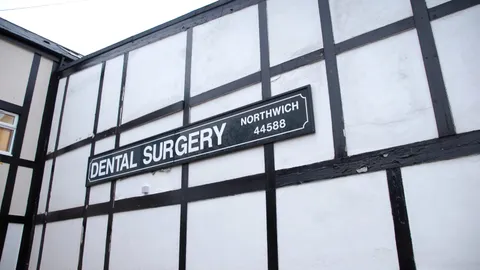
- Cover: „Dental Surgery, Northwich, Cheshire”, author: kitchenkraft, licence CC BY 2.0; cropped or resized.
- Photo 1: „COVID-19 Vaccine Vials In A Row”, author: Chic Bee, licence CC BY 2.0; cropped or resized.
- Photo 2: „Pregnancy/Baby Bump”, author: Margaret Barse, Alabama Extension, licence CC0 1.0; cropped or resized.
Tags
Share with friends