"Maczuga" 1944: how the Polish 1st Armoured Division blocked the German retreat at Chambois
In August 1944, soldiers of Gen. Stanisław Maczek's 1st Armoured Division took the Mont Ormel hills in Normandy, which they called "Maczuga" (the Mace). This cut one of the main German retreat routes.
Author: Editorial teamPublished: 2 min read
Contents
The battle for Hill 262 in Normandy, known in Polish tradition as "Maczuga" (the Mace), is one of the most important episodes in the combat history of Gen. Stanisław Maczek's 1st Armoured Division. It is recalled by Onet Kultura, and its course is also described in publications by the Institute of National Remembrance (IPN).
The Falaise trap
The Battle of Falaise lasted from 7 to 22 August 1944. The Allies had encircled German forces around Falaise, and the route of withdrawal into France narrowed to a corridor less than 30 km wide. Closing it was entrusted to, among others, the 1st Armoured Division, fighting as part of the 1st Canadian Army. The division was formed on 25 February 1942 on the orders of Commander-in-Chief Gen. Władysław Sikorski.
Why these hills
According to the IPN, on 18 August 1944 Gen. Maczek sent the 1st Armoured Regiment and a Podhale battalion under Col. Stefanowicz to the Mont Ormel hills. They are two rises 262 m above sea level. The general named them Maczuga because of the shape of the contour lines on the map. The hills were strategically important because the road from Chambois to Vimoutiers, one of the main retreat routes of German Army Group B, ran between them.
Col. Stefanowicz's group went up onto Maczuga on 19 August. From there it could fire on the German retreat routes. Canadian heavy artillery, directed from the hill, also joined the fight.
Surrounded on the hill
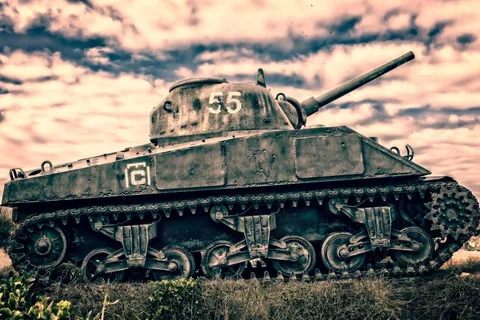
In the night of 19 to 20 August the position was reinforced by Col. Kosztulski's group, which included the 2nd Armoured Battalion and the 8th and 9th Rifle Battalions. According to the IPN there were then around 80 Polish tanks and about 1,500 infantry on Mont Ormel. Canadian and American units that were meant to reach the Poles on 20 August were halted. The Poles were surrounded.
The Germans tried to break out of the encirclement, while the II SS Panzer Corps attacked from outside to open a way. The assault began on 20 August after 10:00. It involved the 9th SS Panzer Division "Hohenstaufen" and the 2nd SS Panzer Division "Das Reich". "Hohenstaufen" headed for Thurn to repel the Canadians. "Das Reich" struck the Poles. The IPN says Polish positions sometimes changed hands several times, but the German attack ultimately collapsed.
Many German soldiers, including wounded men, surrendered on the hill without a fight. According to the IPN, the Polish medical equipment was destroyed and the doctor was killed.
Remembrance
A monument commemorating the battle stands on Hill 262 today. Annual ceremonies are held there with a field Mass and the laying of flowers, attended by Polish soldiers among others. The name "Maczuga" has become established in Polish and foreign literature on the Normandy campaign.
Sources
This article was prepared automatically by AI from the listed sources and published without prior editorial review. Spotted a mistake? Use the “Report an error in this article” button.
Photos
- Cover: „tank, memorial, france, normandy, d-day”, author: Tama66, licence Pixabay Content License; cropped or resized.
- Photo 1: „etretat, normandy, church, architecture, france”, author: Dylanleagh, licence Pixabay Content License; cropped or resized.
Tags
Share with friends