EU Settlement Scheme: settled and pre-settled status, share codes
How settled status differs from pre-settled status, how your eVisa and UKVI account work, how to generate a share code for an employer or landlord, and what changed in 2026 on automatic upgrades from pre-settled to settled status and on removing pre-settled status.
Author: AdministratorPublished: 8 min read
Contents
In short
- The EU Settlement Scheme (EUSS) gives EU, EEA and Swiss citizens who were living in the UK before the end of 2020 (and their families) the right to live, work and study here and to use the NHS. Your status is linked to you, not to your passport.
- Settled status is usually granted after 5 years of continuous residence. Pre-settled status is for people who have lived here for a shorter time.
- Proof of your status is your eVisa in your UKVI account, not the decision letter. You give employers and landlords a share code.
- In 2026 the Home Office changed the rules on automatically upgrading pre-settled to settled status and began removing pre-settled status from people it believes have stopped living in the UK. Keeping the contact details in your UKVI account up to date therefore really matters.
- Applying to the EUSS is free. Do not pay any ‘agent’.
What EUSS status is
Both types of status give you the right to work, study, use the NHS free of charge and access public funds (if you currently qualify), and to travel to and from the UK. They differ in how long they last and what happens if you are away for a long time.
| Settled status | Pre-settled status | |
|---|---|---|
| Who it is for | Usually after 5 years' residence | Usually under 5 years' residence |
| Nature | Right to stay with no time limit | Temporary, extended |
| Absence | Up to 5 years in a row outside the UK (4 years for Swiss citizens) | You must keep up continuous residence |
You do not choose the type of status in your application: it depends on how long you have lived here. Settled status can be granted earlier in some cases, for example to the child of someone with settled status. Once you have it, you can usually apply for British citizenship after 12 months (if you meet the other requirements).
New arrivals: the EUSS is for people who were living in the UK by 31 December 2020 (and some of their family members). People who arrived later on their own cannot use it (see the guide: Your first 30 days in the UK — a checklist of things to sort out).
Pre-settled status: automatic extension and upgrade to settled (as of 2026)
This is the part of the rules that changes most (as of October 2026, check the current rules: GOV.UK and Home Office publications).
Five-year extension. GOV.UK says that if you have pre-settled status, it will be extended by 5 years before it expires, and you will get an email telling you so. The extension applies to people approaching their expiry date who have not yet been granted settled status. The extension does not change your status to settled.
Automatic upgrade to settled. According to the GOV.UK page on switching status, your status ‘may be automatically switched’. The Home Office checks travel data and, using your NI number, tax records and some benefits records. You will get an email when it is considering switching your status, and another with the outcome.
Changes from 9 April 2026. A Home Office update published on that date explains that:
- automatic upgrades use a test of ‘at least 30 months in the last 60 months’ confirmed by tax and benefits data, instead of the complex rules in the Withdrawal Agreement;
- some groups cannot be upgraded automatically and must apply in the usual way (among them people without 30 months in the data, people who later obtained a different UK immigration status, non-EEA family members and people under 18);
- if an automatic upgrade is not possible, pre-settled status ‘will continue to be extended by five years’;
- the Home Office has begun removing pre-settled status from people who have clearly stopped living in the UK, starting with those who have been outside the UK the longest (the first group is people who have been away for the last five years);
- before deciding to remove status, the Home Office contacts you using the email address and phone number in your UKVI account and gives you a chance to provide evidence of residence or reasons for your absence. There is a right of appeal against such a decision.
What this means for you:
- Keep the email address and phone number in your UKVI account up to date, and check your spam folder too.
- If you have received an email saying that your case is being considered for an automatic upgrade, do not submit an application at the same time (a rule set out on the switching status page).
- If you are not upgraded automatically but you meet the requirements, you can make a free application for settled status yourself. You do not need to have held pre-settled status for 5 years; what counts is how long you have lived here.
- If you receive a message about possible removal of your status, reply by the deadline given and seek legal advice.
The switching status page says, among other things, that you need 5 years' continuous residence and that your absences must stay within the limits: no more than 30 months outside the UK in the last 5 years and no more than 6 months outside the UK in any 12-month period (with exceptions). The automation rules (30 out of 60 months) and the rules on the application page may differ in the detail, so check the current wording on GOV.UK before making a decision.
Travel and absences (continuous residence)

A first application requires you to have spent at least 6 months in the UK in every 12-month period over 5 years. Continuous residence is not broken by a single absence of up to 12 months for an important reason (for example childbirth, serious illness, study or an overseas work posting), or by compulsory military service.
- Settled status: you can be outside the UK for up to 5 years in a row without losing your status. Each time you enter the UK during that period, you can then be away for up to another 5 years (4 years for Swiss citizens).
- Pre-settled status: you must keep up continuous residence. If you do not, the Home Office can cancel your pre-settled status. Your status lapses automatically if you spend more than 5 years in a row outside the UK.
- Losing your status usually means you need a visa to live and work in the UK.
Before you travel, check that the document you are travelling on is linked to your UKVI account. A carrier (for example an airline) may refuse to let you board if the details do not match.
Your eVisa and UKVI account
Your EUSS status is held as an eVisa — a digital record of your identity and immigration status. You access it through your UKVI (UK Visas and Immigration) account. If you applied to the EUSS, you probably already have one. GOV.UK warns: if you already have a UKVI account, do not create a second one.
- The decision letter is not proof of your status. Your eVisa and a share code serve as proof.
- To sign in to the ‘View and prove’ service you need your passport, national identity card, biometric card (valid or expired), an expired BRP or your UKVI customer number, plus access to the phone or email linked to your account.
- When creating a new account, an expired BRP can only be used for 24 months after its expiry date or until 31 December 2026 (whichever is sooner).
- A UKVI account is free. GOV.UK says that access to your eVisa is usually immediate once your account is linked, but it can take up to 24 hours.
- If your eVisa contains a mistake, report it using the form on GOV.UK.
Share codes: right to work and right to rent

How to generate a share code:
- Go to GOV.UK: View and prove your immigration status.
- Sign in to your UKVI account.
- Choose who you want to prove your status to (an employer — right to work, a landlord — right to rent). Before generating the code, the service shows you what information the other party will see.
- You will get a code that is valid for 90 days. You can use the code as many times as you like during that period, and once it expires you generate a new one.
- Give the code and your date of birth to your employer (right to work) or landlord (right to rent). They do not need to see your eVisa themselves.
Generate separate codes for your employer and your landlord.
Right to rent. Right to rent checks apply only in England. In Wales, Scotland and Northern Ireland you do not have to prove your right to rent (GOV.UK: prove your right to rent). A landlord cannot turn you down if, instead of a code, you choose to show documents from the list of accepted documents.
Watch out for scams. You generate a share code yourself, free of charge, on GOV.UK. Do not give your code or your UKVI login details to people who ask for them by message, phone or on a listings website. Be wary of websites that ‘help’ with the EUSS for a fee.
Changing your passport or details in your UKVI account
GOV.UK requires you to keep the details in your UKVI account up to date, for example after getting a new passport.
- Using the update service, you can change: your passport or other travel document (you can add a second one), your name, phone number, email address, postal address, date of birth (corrections only), nationality, and your photo if your appearance has changed.
- To change your name, date of birth or nationality, you need a document confirming the change.
- If you cannot update your details online, for example because you are abroad, you can ask UKVI for help or have your photo taken at a visa application centre.
- The service does not change immigration details such as your visa.
Late applications
The deadline for most people was 30 June 2021. You can still apply if you are eligible for the EUSS (for example you lived in the UK before the end of 2020) and you have reasonable grounds for the delay. You must explain why you did not apply by the deadline and why you have not done so since, providing evidence for each reason you give.
Examples from GOV.UK: a parent, guardian or local authority did not apply on your behalf when you were a child; serious illness; lack of capacity to apply; abuse or coercive control in a relationship; other compelling practical or compassionate reasons.
Some groups have later deadlines; for example, family members joining someone with EUSS status after 1 April 2021 usually have 90 days from their most recent arrival in the UK. British citizens usually cannot use the EUSS (there are exceptions, including for some dual nationals and their families — check GOV.UK). Irish citizens do not need to apply.
You apply online on GOV.UK. If you cannot use the online service, contact the Resolution Centre, which will usually send you a paper form to post back.
Where to get help
- EU Settlement Resolution Centre / UKVI — questions about your application, mistakes in your status. Current numbers and opening hours are given by the contact tool: gov.uk/contact-ukvi-inside-outside-uk.
- Registered immigration advisers — the Immigration Advice Authority's adviser finder on GOV.UK; some offer free help: gov.uk/guidance/information-for-advice-seekers.
- Help with the online application (assisted digital) and a finder for registered advisers: gov.uk/help-eu-settlement-scheme and gov.uk/assisted-digital-help-online-visa-applications.
- Citizens Advice — general help if you have problems with a decision: citizensadvice.org.uk.
- If your status is being removed or you want to appeal, get help from a qualified adviser.
Sources
Information verified:
- EU Settlement Scheme: settled and pre-settled status — What you'll get
- Switch from pre-settled to settled status
- EU Settlement Scheme: who can apply (eligibility and late applications)
- EU Settlement Scheme (EUSS) status automation update (April 2026)
- Apply to the EU Settlement Scheme
- After you've applied (EU Settlement Scheme)
- View and prove your immigration status (eVisa) and get a share code
- Get access to your eVisa (UKVI account)
- Update your UK Visas and Immigration account details
- Prove your right to rent
- Get help applying to the EU Settlement Scheme
- Prove your right to work to an employer using your immigration status
- Get help with online visa applications (assisted digital)
Photos
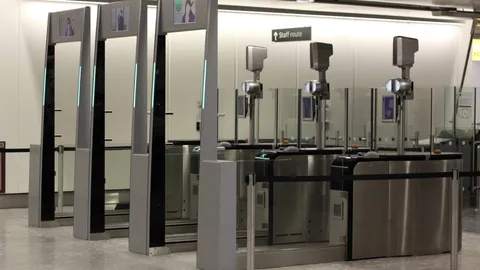
- Cover: „Heathrow Terminal 4 ePassport gates”, author: Home Office, licence CC BY 2.0; cropped or resized.
- Photo 1: „Stansted airport entrance”, author: bjaglin, licence CC BY 2.0; cropped or resized.
- Photo 2: „Hands Typing on Notebook Computer”, author: Image Catalog, licence CC0 1.0; cropped or resized.
Tags
Share with friends